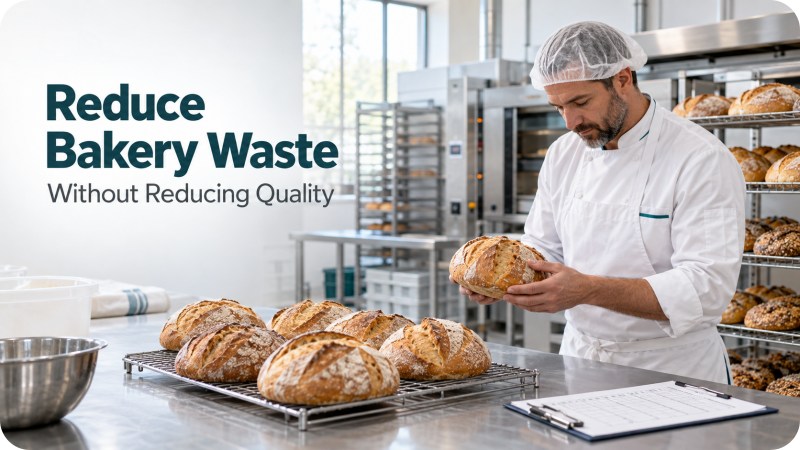
Reducing bakery waste starts with preventing avoidable losses, not accepting poorer bread or smaller portions. An unsold loaf, a rejected tray, and flour lost during handling have different causes. Treating them as one problem often leads to the wrong response.
For bakery owners and production managers, the objective is consistent, saleable output that matches demand. Keep your product specifications fixed while improving planning and process control. This approach also follows the prevention priority in the US Environmental Protection Agency's Wasted Food Scale [1]. The practical question is where your bakery loses usable material, and what can change without weakening quality.
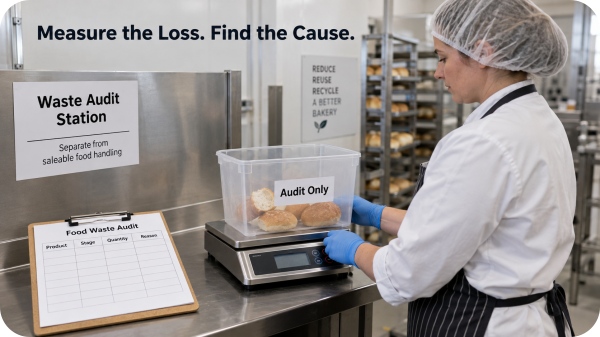
Measure Waste Before Changing Production
Start with a representative week, including quieter days and busy shifts. Record losses by product, production stage, quantity, and reason. Separate ingredient spoilage, dough handling losses, baking rejects, packaging damage, and unsold finished goods. Record donations and approved recovery separately so they do not hide overproduction.
Use consistent measurements. Compare finished bread waste with finished bread output, not raw dough weight: normal baking moisture loss is not automatically waste. Track kilograms for material losses and units for retail leftovers. Add ingredient cost and processing cost where practical to identify expensive failures.
Assign a clear reason to each entry. "Overproofed before oven available" is more useful than "bad bread." Review the largest recurring loss with the people doing the work, rather than using records to assign blame.
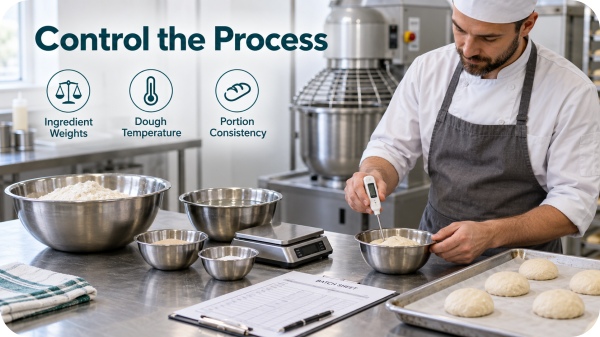
Control Ingredients and Dough Consistently
Weigh ingredients accurately and verify scales with an appropriate checking procedure. Identify opened ingredients, retain batch traceability, and rotate stock according to usable life. Buying larger quantities only saves money when storage conditions and consumption rates support them.
Record water temperature, finished dough temperature, mixing settings, and dough condition. Flour changes, room temperature, and equipment loading can alter results even when the recipe stays unchanged. Establish product-specific targets through trials instead of relying on a universal mixing time.
Check portion weights early and periodically. Consistent dividing reduces giveaway and uneven baking without reducing the declared product size. Do not compensate for repeated overweight portions by making other pieces undersized. Correct the dividing process and confirm the finished weight
specification still holds.
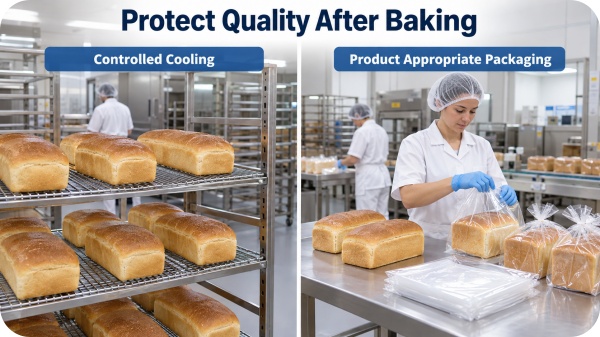
Protect Quality After the Oven
Cooling, slicing, and packing can undo an otherwise successful bake. Allow adequate rack space and airflow, and establish a cooling endpoint appropriate to the product. Bread cooling behavior varies with loaf geometry and the baking profile, as the American Society of Baking explains
Packing bread while it is too warm can create condensation, while excessive exposure can dry it out. Match packaging to the intended crust and shelf life. A crisp artisan loaf and a soft sandwich loaf do not have identical requirements.
Freezing can support planned stock management for suitable products, but validate the complete freeze, storage, and thaw cycle. King Arthur Baking recommends cooling bread before freezing and using airtight storage [3]. Commercial operations should verify texture and handling performance under their own conditions rather than assuming that every product freezes equally well.
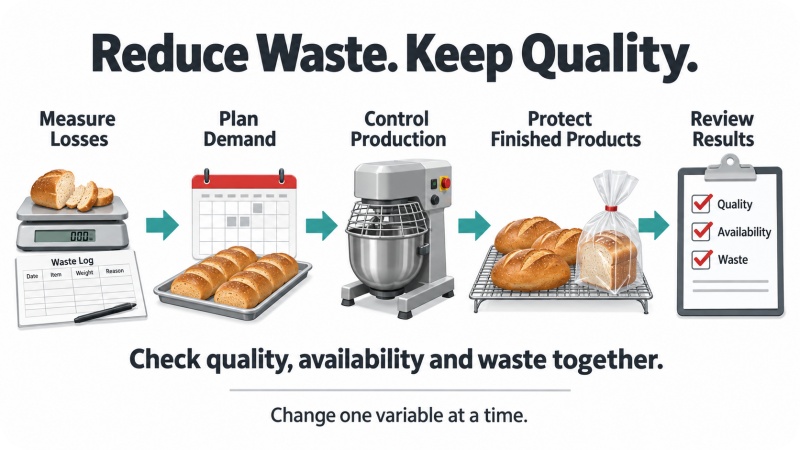
Test Improvements Against Quality
Choose one recurring loss and run a controlled trial. Keep the recipe and quality criteria unchanged while adjusting the suspected cause. Record waste, saleable yield, labor requirements, availability, and complaints. A lower discard total is not an improvement if customers encounter shortages or inconsistent bread.
Conclusion
Bakery waste reduction works best when quality remains the acceptance test. Measure losses accurately, produce to realistic demand, and control the stages that determine saleable yield. Recover safe surplus responsibly, but prioritize preventing repeat losses. The result should be fewer avoidable rejects and leftovers, with the product customers expect still intact.
FAQ
What is the first step in reducing bakery waste?
Measure losses by product, stage, quantity, and reason over a representative period. Separating production rejects from unsold stock helps you choose whether to address process consistency, demand planning, or both.
Can smaller batches reduce waste without affecting bread quality?
Yes, when smaller batches match demand and remain within equipment operating limits. Validate mixing performance and the complete production schedule first. Very small batches can increase handling variation and operating costs.
Should a bakery reduce portion sizes to save ingredients?
Do not reduce the specified product size as a hidden waste measure. Instead, improve dividing accuracy so pieces consistently meet the intended finished weight. Review declared weights and customer specifications whenever changing a product.
Looking for More Consistent Baking Results?
With 47 years of manufacturing experience and exports to 120+ countries, we help bakeries improve product consistency and production efficiency.

HONGLING provides complete bakery solutions including: • Dough Sheeters • Dough Proofers • Rotary Rack Ovens • Deck Ovens • Spiral Mixers • Cooling Solutions
Contact our team today to discuss your bakery project and receive a customized solution..
Related Articles
Baking Soda vs Baking Powder vs Yeast: What's the Difference?
Deck Oven vs Convection Oven vs Rotary Rack Oven
Spiral Mixer vs Planetary Mixer: Which One Does Your Bakery Need?
Bread Flour vs All-Purpose Flour: Does It Really Matter?
اشترك معنا , يمكنك الحصول على أحدث محتوى منتجاتنا , تقارير إخبارية حصرية وتحديثات , آخر الأحداث المحلية


online service






 +8613066853339