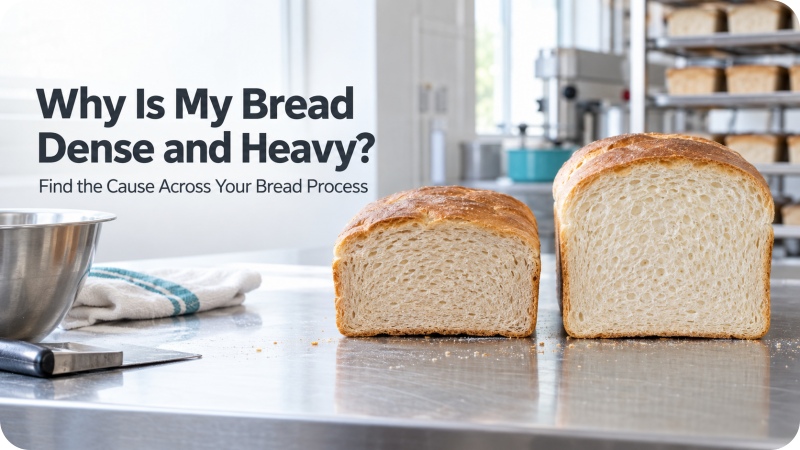
Bread becomes unexpectedly dense when the dough produces too little gas, cannot retain enough gas, or fails to expand and set properly during baking. A gummy, compressed crumb can also result from underbaking or slicing before the loaf has cooled sufficiently. Adding more yeast addresses only one possible part of the problem.
For commercial bakeries, the useful question is where the batch departed from its normal process. Check the formula, mixing, fermentation, shaping, baking, and cooling in sequence. This approach helps identify a repeatable cause instead of making several changes that leave the next batch equally unpredictable.
Check Fermentation Before Increasing Yeast
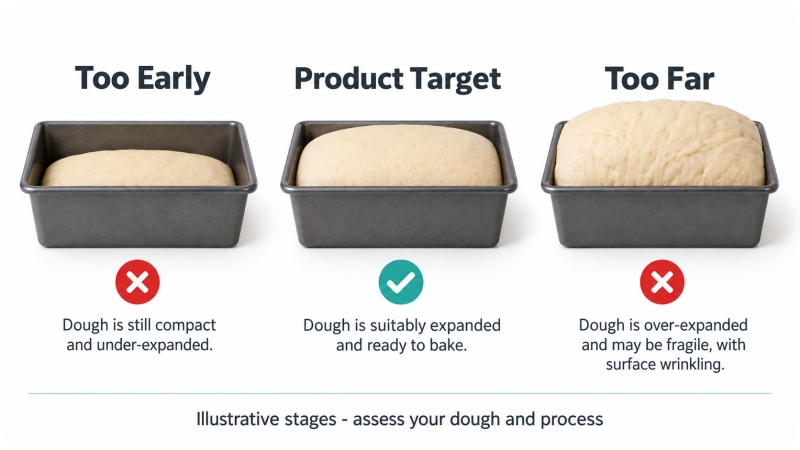
Underfermented dough may reach the oven before enough gas has accumulated and before it has developed the intended characteristics. This can happen when the dough is colder than usual, the yeast is weak, or the schedule is shortened to meet a production deadline.
Measure final dough temperature after mixing and compare it with the validated target. Check yeast storage, weighing records, and product suitability. Sweet doughs and lean doughs may respond differently to the same yeast and schedule.
Overproofing can also reduce loaf volume when dough becomes too fragile to retain its expansion. Review how the dough looked and handled before baking, not just the finished crumb. Use product-specific rise and handling cues alongside elapsed time; a finger-poke test alone is not reliable for every dough, particularly very cold or wet dough.
Reference: King Arthur Baking on proofing readiness
Confirm Flour and Water Are in Balance
Too much flour or too little water can leave dough stiff and limit expansion. Repeated additions of bench flour during handling may gradually change the effective formula, even when the initial weighing was accurate. Record those additions when troubleshooting.
Flours differ in absorption and dough performance. Changing supplier, extraction level, or whole-grain content can require process trials. Protein percentage is useful information, but it does not describe every aspect of flour strength or suitability.
Whole-grain ingredients and inclusions can produce a naturally closer crumb and change water requirements. Do not increase hydration simply to chase larger holes. Excess water without suitable dough strength and handling can create another low-volume loaf. Adjust within a documented trial and assess both processing behavior and baked quality.
Reference: King Arthur Baking on hydration and bread structure
Build Dough Strength Without Overmixing
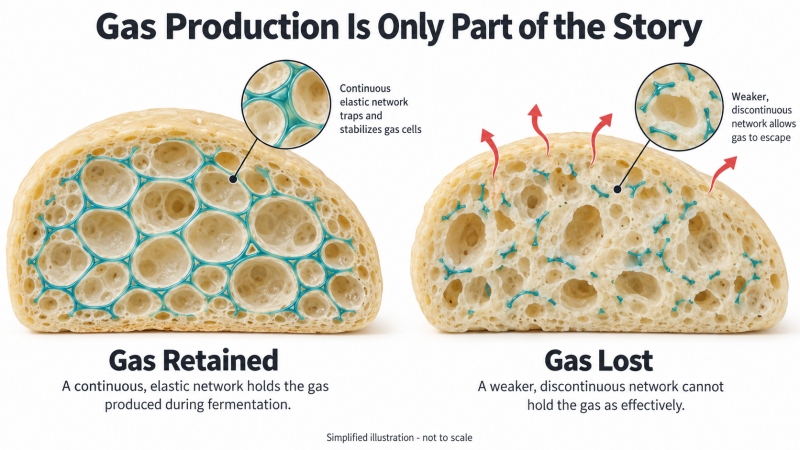
In wheat bread, mixing and resting develop a gluten network that helps retain fermentation gas. Insufficient development can leave dough unable to support the intended volume. However, extending mixing indefinitely is not a solution: intensive mixing can overheat dough and eventually damage its structure.
Check mixer speed, time, batch size, and the actual dough at discharge. A mixing program established for one load may behave differently at another. Assess extensibility and strength using a method appropriate to the formula; a thin windowpane is not a universal endpoint for rye or heavily seeded dough.
If production recently moved to another mixer, repeat product trials rather than copying the old mixing time. Record final dough temperature as well as development so changes in heat do not obscure changes in mixing performance.
Further reading: King Arthur Baking on crumb development
Review Dividing Shaping and Final Proof
Some degassing is intentional, especially for fine-textured pan bread. Excessive compression, tearing, or unsuitable moulder settings can nevertheless reduce gas retention and create tight areas. Check equipment clearances and dough handling against the product standard.
Match dough piece weight to pan size. An oversized pan can make a correctly fermented piece appear unusually short, while a weight increase changes the proofing and baking requirements. Compare actual weights before changing the recipe.
Watch the queue between final proof and oven loading. A batch may be ready at the proofer exit but deteriorate while waiting for oven space. Stable humidity helps prevent surface drying, but it cannot compensate for poor fermentation timing. Coordinate batches with realistic oven availability.
Use a Controlled Trial to Find the Cause
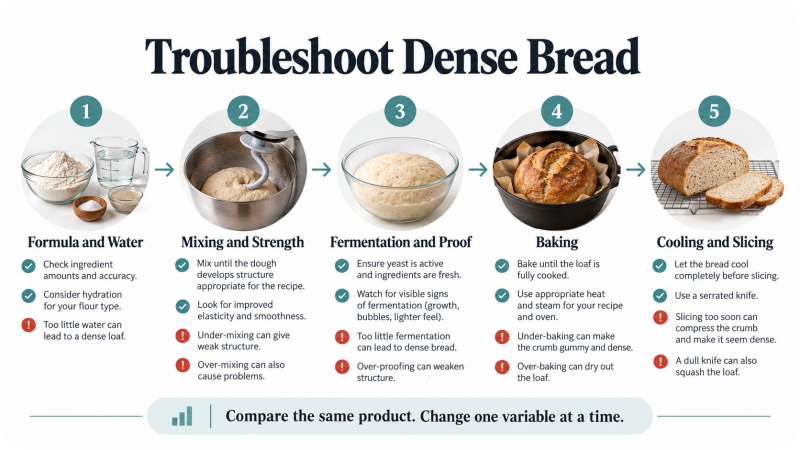
Start with the earliest measurable difference from a successful batch. Record ingredient lots, weights, water temperature, mixing settings, final dough temperature, fermentation observations, oven conditions, and cooling time. Keep the record practical enough for operators to complete consistently.
For example, if dense morning loaves coincide with colder dough, trial a measured water-temperature adjustment while keeping the formula and mixing program unchanged. Observe fermentation progress and compare cooled loaves. Do not simultaneously increase yeast, lengthen mixing, and change the oven temperature.
This is an illustrative investigation, not a documented customer result. Repeat the successful condition before adopting it as a standard. For equipment purchasing, ask suppliers to demonstrate your recipe at representative batch sizes and record the process conditions, not just present an attractive finished loaf.
Conclusion
Dense bread is a result, not a diagnosis. Establish what the product should look and feel like, then trace gas production, gas retention, proofing, baking, and cooling. Accurate measurements and controlled trials help bakery teams identify the right correction while protecting the parts of the process that already work.
Part 5 - FAQ
Does dense bread always mean too little yeast?
No. Weak gas retention, unsuitable hydration, proofing errors, underbaking, and early slicing can also produce a heavy result. Check the process records before changing yeast dosage.
Can both underproofing and overproofing make bread dense?
Yes. Underproofed dough may lack sufficient expansion, while overproofed dough can lose its ability to retain gas. Assess the dough before baking and compare the cooled loaf with an approved sample.
Will more water make bread lighter?
It may help a dough that is too stiff, but more water is not a universal solution. Flour absorption, dough strength, product style, and handling must support the change. Test measured adjustments rather than adding water without a record.
Is whole-wheat bread supposed to be denser?
Whole-grain ingredients often produce a closer crumb and change water requirements. That does not make every heavy loaf acceptable. Compare against a validated whole-grain product rather than a white bread reference.
Looking for More Consistent Baking Results?
With 47 years of manufacturing experience and exports to 120+ countries, we help bakeries improve product consistency and production efficiency.

HONGLING provides complete bakery solutions including: • Dough Sheeters • Dough Proofers • Rotary Rack Ovens • Deck Ovens • Spiral Mixers • Cooling Solutions
Contact our team today to discuss your bakery project and receive a customized solution..
Related Articles
Baking Soda vs Baking Powder vs Yeast: What's the Difference?
Deck Oven vs Convection Oven vs Rotary Rack Oven
Spiral Mixer vs Planetary Mixer: Which One Does Your Bakery Need?
Bread Flour vs All-Purpose Flour: Does It Really Matter?
Dough Temperature: The Hidden Number Behind Consistent Bread
اشترك معنا , يمكنك الحصول على أحدث محتوى منتجاتنا , تقارير إخبارية حصرية وتحديثات , آخر الأحداث المحلية


online service






 +8613066853339